
Research
Research is building our understanding of how peer grief support can foster connection, hope, and well-being for children, teens, young adults, and families.
Advancing what we know about peer grief support
Since 1982, Dougy Center has created spaces where children, teens, young adults, and families who are grieving can connect with others who understand. The Dougy Center Model™ is grounded in a humanistic, holistic approach that recognizes grief as a natural response to loss and honors each person as the expert on their own experience.
Research is an important part of continuing to learn, grow, and strengthen this work.
Through research, evaluation, and collaboration, Dougy Center seeks to better understand the experiences of children and young people who are grieving, the role of peer connection and community in supporting them, and the ways grief support can contribute to hope, connection, and well-being.

Research & The Dougy Center Model™
The Dougy Center Model™ is a peer grief support approach developed through more than four decades of working alongside children, teens, young adults, and families who are grieving. Today, more than 500 programs throughout the United States and around the world use or are inspired by the model.
An important body of research conducted by Dougy Center examined the impact of a peer grief support intervention based on principles of The Dougy Center Model™ with youth in foster care.
Two randomized controlled trials (RCTs) studied young people participating in peer grief support and compared their experiences and outcomes with youth assigned to a waitlist control group. Together, these studies provide important evidence about the potential of peer-based grief support for young people whose experiences of loss and grief are often underrecognized.
What the research found
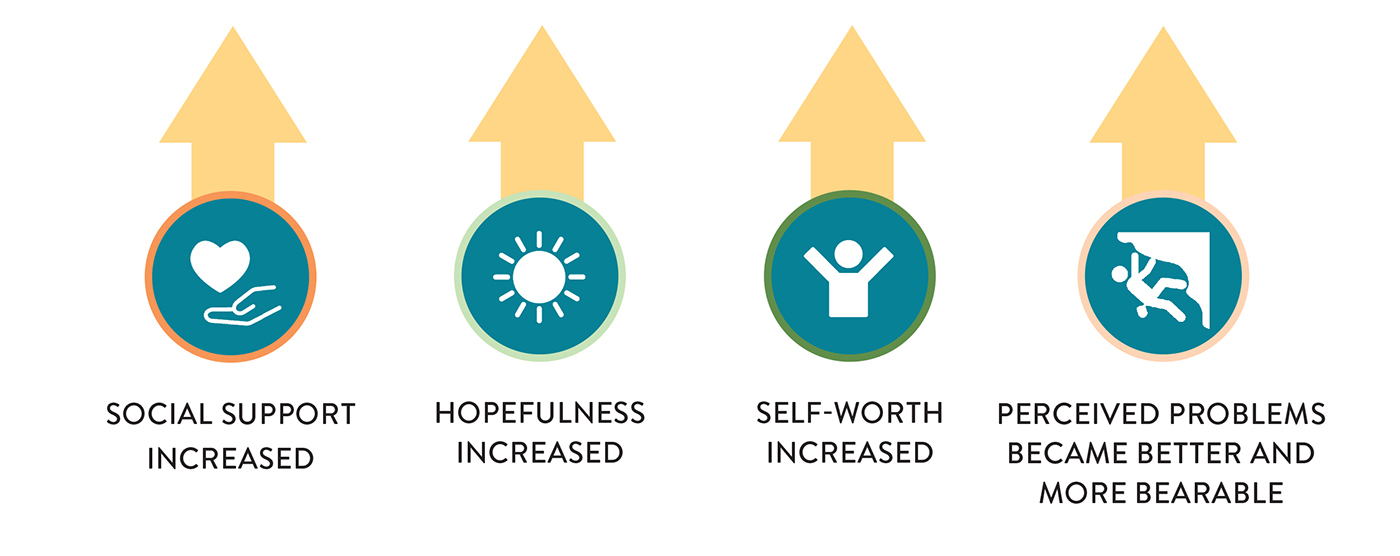
Across the research, youth who participated in peer grief support experienced positive outcomes in four important areas:
Social support increased
Participants reported stronger feelings of connection and support from others.
Hopefulness increased
Young people reported increased hope for themselves and their futures.
Self-worth increased
Participants reported increased feelings of self-worth and value.
Problems felt better and more bearable
Young people reported improvement in how they experienced and managed the problems they were facing.
The second randomized controlled trial followed participants over time and found positive large effects at six months for hopefulness, social support, and self-worth. Youth also described the importance of relational connection, emotional and behavioral support, and having a safe place to talk about how they felt.

Listening to young people
Numbers tell only part of the story.
The research also asked young people directly about their experiences. Participants described the importance of having a place where they could share feelings without judgment, connect with others who understood, receive support, and develop meaningful relationships.
These findings reflect something Dougy Center has learned from children and families throughout our history: grief does not need to be fixed. People who are grieving need opportunities to be heard, understood, and supported.
Peer support creates space for that connection.
Two Randomized Controlled Trials
The research included two randomized controlled trials involving youth in foster care.
The first RCT included 42 youth ages 12–16 living in three foster care group homes. Participants were randomly assigned to either the peer grief support intervention or a waitlist control group. Researchers examined measures including hopefulness, social support, self-worth, perceived problems, and participants' experiences of the program.
The second RCT expanded the research to 78 youth ages 12–20. Participants were again randomly assigned to the peer grief support intervention or a waitlist control group and completed assessments over time, including a six-month follow-up. At six months, researchers observed positive large effects for hopefulness, social support, and self-worth.
As with all research, these studies have limitations—including sample size, attrition, and the degree to which findings can be generalized to other populations. They nevertheless contribute important evidence to a field in which rigorous research on peer grief support, particularly among youth in foster care, has historically been limited.
Research Reports & Publications
More information is coming soon.
Dougy Center is currently developing updated research summaries and resources that will make findings from these randomized controlled trials accessible to families, practitioners, researchers, child welfare professionals, and others interested in peer grief support. This page will be updated as those materials become available.
The findings from this research have also been published in peer-reviewed academic journals, contributing to the growing body of knowledge about grief, loss, and peer support for young people.
Continuing to Learn
Research is not about reducing grief to a set of numbers or determining whether someone is grieving the “right” way. For Dougy Center, research is another way of listening.
It helps us understand what young people tell us about their experiences, examine the impact of peer support, strengthen our practices, and contribute what we learn to the broader fields of childhood bereavement, grief support, and child and family well-being.
As Dougy Center continues to grow, we remain committed to pairing more than four decades of lived experience and practice with thoughtful research, evaluation, and—most importantly—the voices of children, teens, young adults, and families themselves.
Because grief is not a problem to solve. It is an experience to be supported.
Research Partners & Acknowledgments
We are grateful to the community partners, participants, and funders for their support. Special thank you to The Duke Endowment, New York Life Foundation, and South Carolina Department of Social Services.